
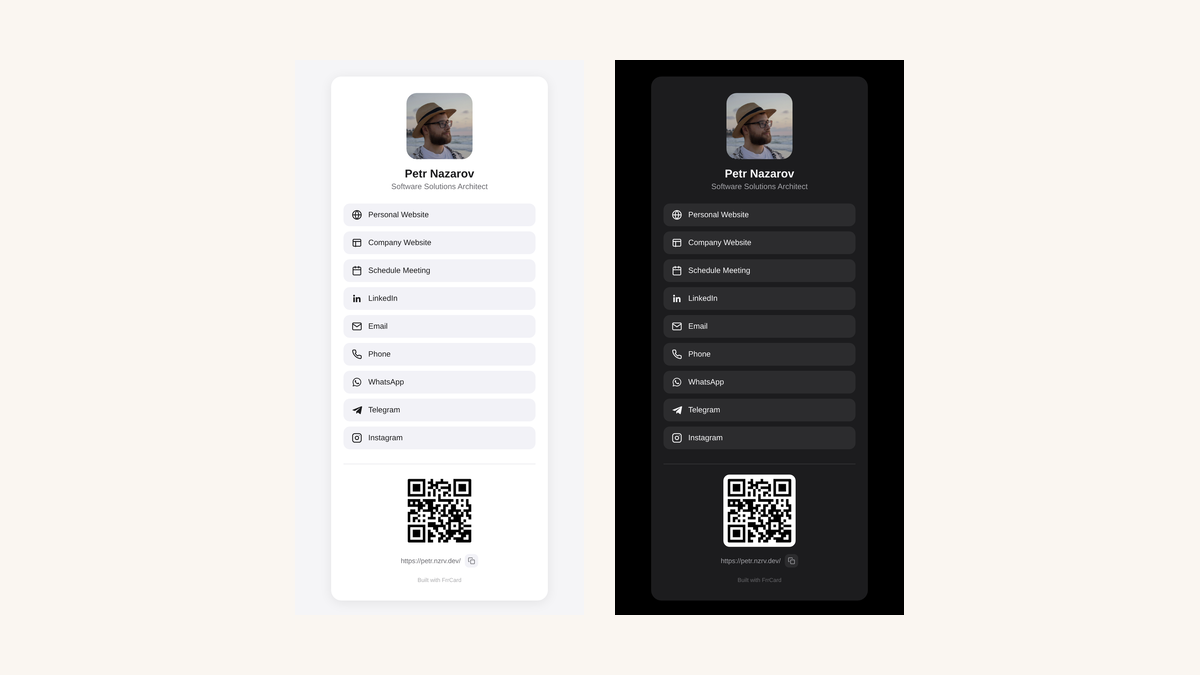
Digital business card services want a monthly subscription for what is, in substance, a single HTML page. FrrCard is that page. You describe yourself in a JSON file, run one command, and get a folder you can drop on any static host — your domain, your server, your contact data.
One file in, one page out
Each data/<name>.json becomes dist/<name>/index.html: name, job title, photo,
and a list of links rendered top to bottom in the order you wrote them. Drop in a
second JSON file and you have a second card, so one repository can serve a whole
family or a whole team.
Links that do the right thing on a phone
Every link declares a type, and the type knows how to become an href. An email
becomes mailto:, a phone number becomes tel: with the punctuation stripped,
WhatsApp becomes wa.me, and a Telegram handle becomes t.me whether you wrote
@handle, handle, or the full URL. Each type brings its own inline SVG icon —
no icon font, no network request.
Nothing to maintain
The renderer is a few hundred lines of plain Node with a single runtime dependency — a QR generator — and the output is static HTML with a system font stack and an automatic light/dark mode that follows the visitor’s setting. There is no framework to upgrade and no database to back up. A built-in QR code and a one-tap copy-link button make it work in person as well as in a signature.
Your data stays yours
The repository tracks the machinery, not the content: data/ and public/ have
their contents ignored, so you can fork it publicly and push freely without
leaking a phone number. Cards reach production through just deploy, which
copies your data to your own server and restarts the released image there — the
JSON never goes anywhere else.
Licence
ISC with the Commons Clause: free to run, fork and redesign for yourself, your family or your employer, but not to resell as a hosted service or a paid fork. That makes it source-available rather than OSI open source — a distinction worth knowing before you build a business on it.